

Optical Satellite Communication Market to Reach US$ 11.72 Billion by 2035, Growing at 21.5% of CAGR from 2025 to 2035
Optical Satellite Communication Market
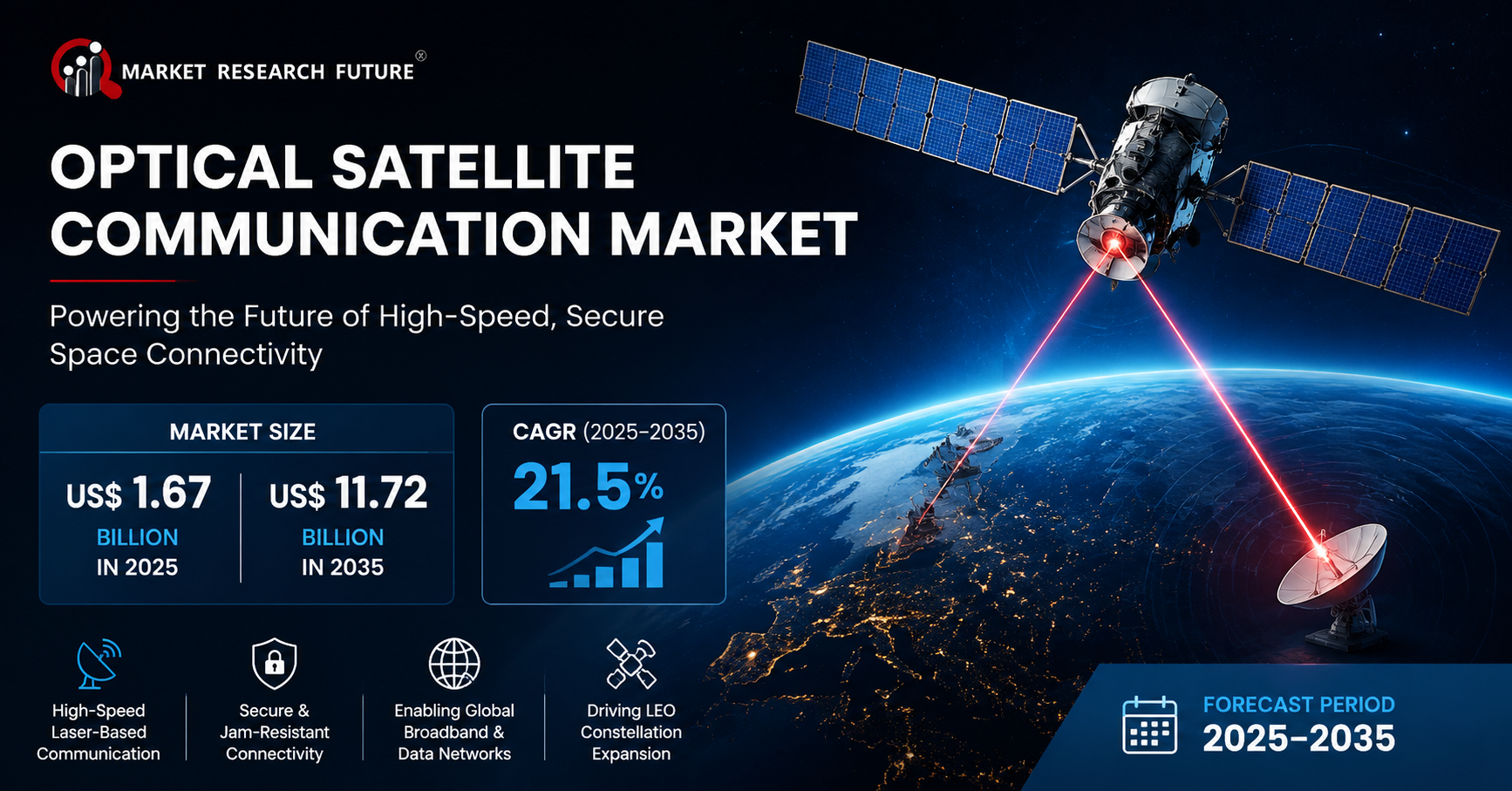
According to industry estimates, the market is projected to expand from US$ 1.67 Billion in 2025 to US$ 11.72 Billion by 2035, registering a robust CAGR of 21.5% during the forecast period (2025–2035). This exponential growth is driven by increasing satellite constellation deployments, rising demand for high-bandwidth space communications, and technological advancements in optical payloads.
Market Overview:
Optical satellite communication leverages laser beams to transmit data between satellites and ground stations, enabling significantly higher data rates than conventional RF systems. This technology supports terabit-scale data transfer, enhanced security, and resistance to electromagnetic interference, making it highly suitable for defense, telecom, and deep-space missions.
Between 2025 and 2035, the industry is expected to transition from experimental deployments to large-scale commercial adoption, especially within Low Earth Orbit (LEO) satellite constellations, which dominate next-generation broadband and Earth observation networks.
Request Sample PDF of Report: https://www.marketresearchfuture.com/sample_request/30093
Latest Trends in the Optical Satellite Communication Market:
1. Expansion of LEO Satellite Constellations
A major trend shaping the market is the rapid deployment of Low Earth Orbit (LEO) satellite constellations. These networks increasingly rely on optical inter-satellite links to manage large volumes of data and ensure seamless global coverage with lower latency compared to traditional RF systems.
2. Growing Adoption of Laser Communication Terminals (LCTs)
Satellite manufacturers are increasingly integrating laser communication terminals into payloads to enable high-speed, secure, and energy-efficient data transmission between satellites and ground stations. This is becoming a standard feature in next-generation spacecraft design.
3. Miniaturization of Optical Communication Systems
Advancements in photonics have led to the development of compact and lightweight optical communication modules, making them suitable for CubeSats and small satellite platforms. This trend is significantly expanding adoption across commercial satellite operators.
4. Rising Demand for High-Bandwidth Space Connectivity
The exponential growth in Earth observation data, remote sensing, and broadband services is driving demand for ultra-high-capacity optical communication links, capable of supporting terabit-level data transmission from space.
5. Integration with Next-Generation Telecom Networks
Optical satellite communication is increasingly being aligned with 5G and emerging 6G infrastructure, enabling hybrid space-terrestrial networks that extend high-speed connectivity to remote and underserved regions.
6. Enhanced Focus on Secure Space Communication
Due to its narrow beam divergence and low interception risk, optical communication is gaining traction in defense and government applications, where secure and jam-resistant communication is a critical requirement.
Market Drivers:
1. Explosive Growth in Satellite Data Traffic - The rise of Earth observation, climate monitoring, and real-time imaging has significantly increased data generation from space, requiring faster transmission systems.
2. Increasing Defense and Military Adoption - Defense agencies are rapidly adopting optical satellite communication for secure, jam-resistant communication in strategic operations.
3. Demand for High-Bandwidth Connectivity - Global demand for broadband internet, especially in remote areas, is pushing the adoption of satellite-based high-speed optical links.
4. Technological Advancements in Photonics - Breakthroughs in laser diodes, modulators, and optical amplifiers are enhancing system performance and reducing costs.
5. Growth of Commercial Space Industry - Private space companies are investing heavily in satellite constellations, accelerating the commercialization of optical communication systems.
Market Opportunities:
1. Expansion in Emerging Markets - Developing regions are expected to adopt satellite-based optical communication for bridging digital infrastructure gaps.
2. Deep Space and Interplanetary Communication - Future space missions, including lunar and Mars exploration programs, present major opportunities for optical communication systems.
3. Autonomous Satellite Networks - AI-driven satellite constellations will require high-speed optical interlinks for real-time coordination and data exchange.
4. Commercial Broadband Services - Satellite internet providers can leverage optical communication to deliver ultra-fast global broadband services.
5. Government and Space Agency Investments - Increasing funding from agencies like NASA, ESA, ISRO, and others is accelerating R&D in optical communication technologies.
Recent Developments in Optical Satellite Communication Market:
January 2025 - The market saw increased progress in the integration of laser communication terminals (LCTs) into next-generation satellite constellations. Manufacturers focused on improving pointing, acquisition, and tracking (PAT) systems, enabling more stable and accurate inter-satellite optical links for high-speed data transfer in Low Earth Orbit (LEO) missions.
August 2025 - Advancements were recorded in inter-satellite optical link (OISL) technology, driven by rising demand for high-bandwidth satellite communications. Companies enhanced free-space optical communication systems to improve data rate capacity, latency performance, and overall link reliability across expanding satellite networks.
November 2025 - The industry moved closer to large-scale commercialization, with broader adoption of optical communication payloads in satellite constellations. Focus increased on standardization of optical terminal architectures, supporting interoperability and scaling of global satellite broadband and Earth observation services.
January 2026 - Technological improvements in miniaturized optical communication systems, including CubeSat-compatible terminals, gained momentum. These developments improved power efficiency and system reliability, making optical communication more viable for small satellite deployments.
May 2026 - The sector continued expanding toward full commercialization, with growing deployment of laser-based satellite communication infrastructure. Investments in optical ground stations and inter-satellite laser networks strengthened the ecosystem required for high-capacity global space communication systems.
Top Companies in the Optical Satellite Communication Market:
1. Airbus SE - Airbus is actively involved in developing advanced optical communication payloads and satellite systems for defense and commercial applications. The company focuses on inter-satellite laser links for secure and high-speed data transmission.
2. Thales Alenia Space - A key European aerospace player specializing in satellite communications systems, including optical terminals designed for LEO and GEO satellite networks.
3. Northrop Grumman Corporation - Northrop Grumman is heavily invested in space communication infrastructure, particularly secure laser communication systems for defense and government missions.
4. Maxar Technologies - Maxar focuses on Earth observation satellites and integrates advanced optical communication systems to support real-time high-resolution data delivery.
5. MDA Ltd. - A Canadian aerospace company specializing in space robotics and satellite communication systems, including optical payload integration.
6. Planet Labs PBC - Planet Labs utilizes satellite constellations for continuous Earth imaging and increasingly adopts optical links to enhance data transmission efficiency.
7. BlackSky Technology Inc. - BlackSky leverages real-time geospatial intelligence platforms supported by high-speed satellite data transmission technologies.
8. Rocket Lab USA - Rocket Lab contributes to satellite deployment and space systems development, supporting next-generation optical communication payload integration.
Regional Analysis:
North America - North America dominates the optical satellite communication market due to strong investments from NASA, the U.S. Department of Defense, and leading private aerospace companies. The region leads in both technological innovation and satellite deployment scale.
Europe - Europe is a major hub for optical communication development, driven by organizations like ESA and companies such as Airbus and Thales. The region emphasizes secure communication systems for defense and Earth observation.
Asia-Pacific - Asia-Pacific is expected to witness the fastest growth due to rising investments from China, India, and Japan in space exploration and satellite broadband initiatives. Government-backed programs are accelerating adoption.
Middle East & Africa - The region is gradually adopting satellite communication technologies for defense modernization, smart infrastructure development, and remote connectivity solutions.
Latin America - Growth is driven by expanding demand for rural connectivity and increasing adoption of satellite-based broadband services across remote geographical areas.
Segment Analysis:
1. By Component
Optical Transceiver Terminals - These are the core communication units responsible for converting electrical signals into optical signals and enabling high-speed laser-based data transmission between satellites and ground stations. They play a critical role in ensuring long-distance, high-bandwidth connectivity in space networks.
Optical Ground Stations - These stations are responsible for receiving and transmitting laser signals between space and Earth. They are essential for maintaining continuous data flow, especially for high-throughput satellite communication systems.
Beam-Steering Assemblies - Beam-steering systems ensure accurate alignment of laser beams between moving satellites. They are crucial for maintaining stable optical links in dynamic orbital conditions.
Signal Processing & Modems - This segment handles encoding, decoding, and processing of optical signals, ensuring data integrity, error correction, and efficient communication across satellite networks.
Others - Includes supporting optical components and subsystems that enhance overall system performance and reliability.
2. By Orbit
Low-Earth Orbit (LEO) - LEO dominates the market due to increasing deployment of satellite constellations requiring low-latency, high-speed optical inter-satellite links.
Medium-Earth Orbit (MEO) - MEO satellites use optical communication for navigation, communication, and regional coverage with improved data capacity compared to traditional RF systems.
Geostationary Orbit (GEO) - GEO satellites utilize optical links for long-distance, stable communication, especially for broadcasting and high-capacity data relay applications.
High-Elliptical & Cislunar - This segment is gaining importance for deep-space missions and extended coverage beyond Earth orbit, enabling advanced scientific and exploration missions.
3. By Payload
Small Satellite (< 300 kg) - Small satellites are increasingly adopting miniaturized optical communication systems due to lower cost and ease of deployment in large constellations.
Medium Satellite (300–1,000 kg) - These satellites balance payload capacity and performance, supporting moderate-to-high bandwidth optical communication systems for commercial and scientific missions.
Large Satellite (> 1,000 kg) - Large satellites integrate advanced optical systems for high-capacity communication, deep-space operations, and defense-grade applications.
4. By End-User
Government & Defense - This segment leads adoption due to high demand for secure, encrypted, and jam-resistant communication systems for strategic and military operations.
Commercial Telecommunications - Telecom operators are increasingly using optical satellite communication to expand global broadband coverage and support next-generation connectivity services.
Academic & Scientific - Research organizations and space agencies use optical communication for deep-space exploration, astronomy missions, and experimental satellite programs.
Others - Includes commercial space startups and specialized mission operators leveraging optical communication for niche applications such as Earth observation and IoT connectivity.
Market Outlook:
The Optical Satellite Communication Market is entering a high-growth phase supported by rapid technological evolution and increasing demand for global high-speed connectivity. With a projected CAGR of 21.5%, the market is expected to expand nearly sevenfold by 2035, positioning optical communication as a foundational technology for future space-based networks.
The transition from RF-based systems to laser-based communication represents a structural shift in satellite communications, enabling faster, more secure, and more scalable global data infrastructure.
Browse More Reports:
Airborne Satellite Communication Market
https://www.marketresearchfuture.com/reports/airborne-satellite-communication-market-31437
Anz Satellite Communications Market
https://www.marketresearchfuture.com/reports/anz-satellite-communications-market-42334
Satellite Communication Market
https://www.marketresearchfuture.com/reports/satellite-communication-market-8466
Sagar Kadam
Market Research Future
+1 628-258-0071
sales@marketresearchfuture.com
Visit us on social media:
LinkedIn
Facebook
X
Legal Disclaimer:
EIN Presswire provides this news content "as is" without warranty of any kind. We do not accept any responsibility or liability for the accuracy, content, images, videos, licenses, completeness, legality, or reliability of the information contained in this article. If you have any complaints or copyright issues related to this article, kindly contact the author above.
