

IT Brand Pulse Releases Landmark Personal AI Memory Report Forecasting a $687 Billion Market Opportunity
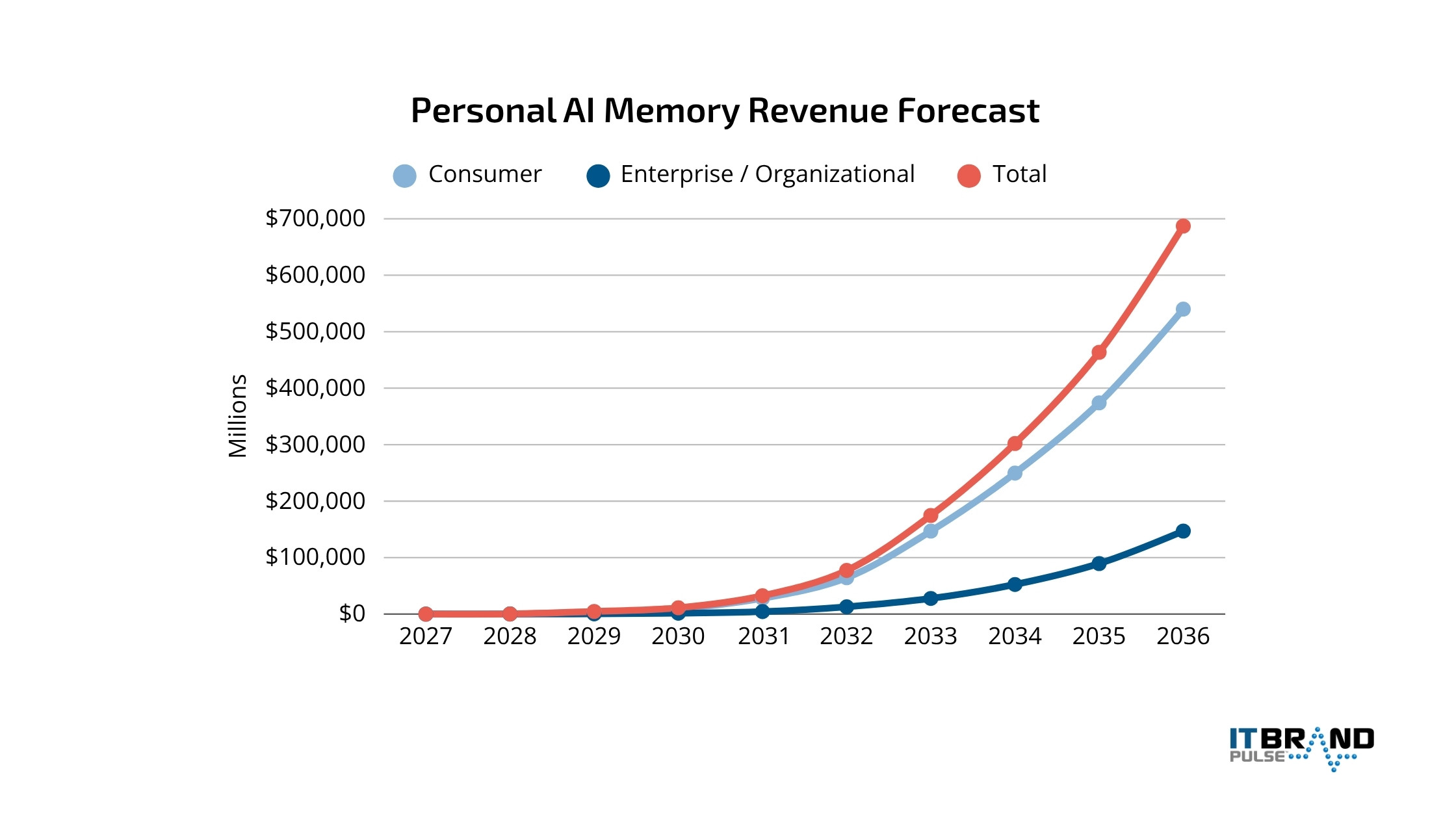
The Result: Our forecast accounts for AI users, adoption rate, pricing, and two market segments.
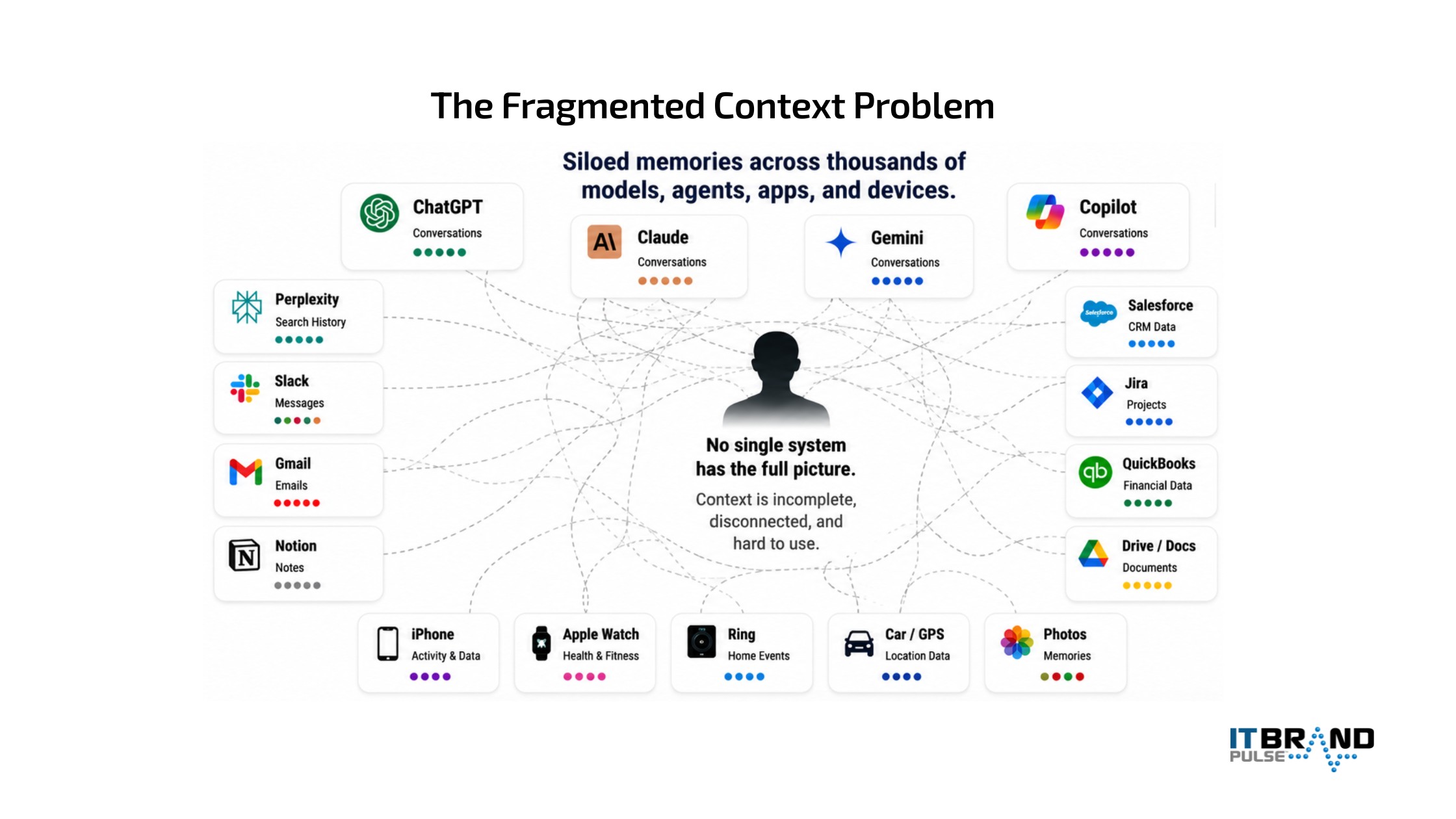
The Problem: Humans have one memory. AI has thousands. This creates fragmented memory and context.
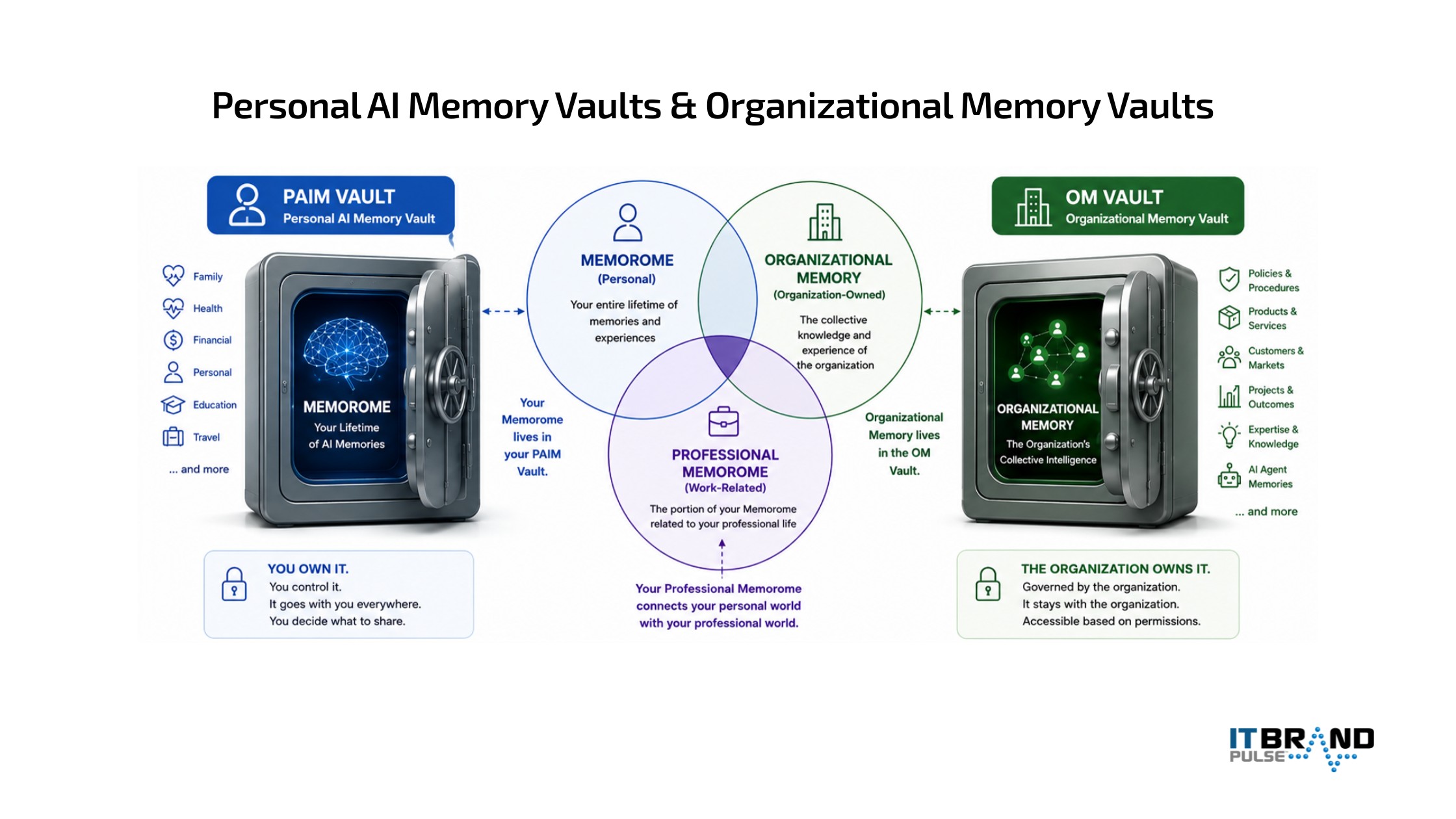
The Solution: Memory and context unified in personal AI memory vaults and organizational memory vaults.
First comprehensive market model predicts Personal AI Memory will become as common as smartphones among AI users.
The report argues that while the AI industry has largely solved the problem of AI amnesia through memory features, vector databases, agent memory frameworks, and persistent memory infrastructure, a much larger challenge remains unresolved: the fragmentation of memory and context across thousands of AI models, agents, applications, devices, and cloud platforms.
"Humans have one memory. AI has thousands," said Frank Berry, Senior Analyst at IT Brand Pulse. "Every AI assistant, application, and device remembers something different. The next major evolution in AI is unified memory and context."
The report introduces Personal AI Memory (PAIM) as a new software category designed to unify memories from across an individual's digital life into a persistent, portable memory system capable of delivering context-aware intelligence across models, applications, and devices.
According to Shawn Shen, CEO of Memories.ai, "If your memory does not belong to you, it is not memory, it is surveillance. A Personal AI Memory app, owned by the individual and running where their data lives, is the only structure that scales. Anything else is a feature inside someone else's product." He added, "The smartphone is the closest analogy, but the mechanic is stronger. A phone makes you contactable. A memory layer makes you smarter, your agents more useful, and your day recoverable. Once a meaningful fraction of the population has it, the social pressure to have it follows."
Key Findings from the Report
Personal AI Memory may become one of the largest software categories of the AI era.
IT Brand Pulse forecasts a potential $687 billion market opportunity driven by billions of AI users adopting persistent memory systems that function as lifelong cognitive companions.
“Personal AI Memory is an immediate and large opportunity,” said Charles Fan, CEO and co-founder of MemVerge. “We believe that memory is the most precious asset for every individual and organization. Solutions are needed to protect and curate it for its rightful owners and apply it as context for optimal AI experiences without compromising privacy. MemVerge is excited to deliver the state-of-the-art Personal AI Memory to everyone.”
Unified Context is the breakthrough.
The report identifies fragmented memory and fragmented context as the primary limitations of current AI systems. Personal AI Memory addresses this challenge by assembling relevant memories from many sources into Unified Context at the moment it is needed.
The Memorome emerges as a new digital asset class.
The report introduces the concept of the Memorome, a person's lifetime collection of AI memories, experiences, knowledge, relationships, preferences, and contextual information accumulated across memory domains such as work, family, education, finance, healthcare, episodic memory, semantic memory, and procedural memory.
Personal & Organizational Memory Vaults become systems of record for AI memory.
According to the report, Personal Memory Vaults will serve as secure repositories for an individual's Memorome, while Organizational Memory Vaults become the enterprise equivalent for preserving institutional knowledge and collective intelligence.
Cognitive Orchestration becomes the industry's most difficult technical challenge.
The report argues that storing memories is only part of the solution. Future systems must determine which memories matter in a given situation and assemble the right context at the right time. IT Brand Pulse calls this challenge Cognitive Orchestration.
The Future is Perceptual Memory.
The report predicts future Personal AI Memory systems will allow humans to remember and retrieve what we write, read, hear, see, experience, learn, and feel through our computers, phones, cameras, wearables, and devices in the future.
What's Inside the Report
• A comprehensive definition and taxonomy for Personal AI Memory and what happens when Personal AI Memory enters the Enterprise
• Introduction of Memoromes, Personal Memory Vaults, Organizational Memory Vaults, and Professional Memoromes
• Analysis of the problem: Humans have one memory but AI memory and context is fragmented
• A framework for the solution: Unified Memory and Context
• A detailed vendor alignment analysis covering OpenAI, Anthropic, Google, Microsoft, Mem0, Zep, Letta, MemVerge, Limitless, Plaud, Memories.ai, and ZetaChain
• The capabilities required to build a winning Personal AI Memory platform
• Consumer and enterprise market forecast including number of users, adoption rate, pricing, and revenue from 2027 through 2036.
• A Personal AI Memory Industry Road Map
Why the Report Matters
The report suggests that Personal AI Memory represents a fundamental shift in how AI systems interact with humans. Rather than acting as isolated assistants with limited context, future AI systems may function as persistent cognitive companions capable of leveraging an individual's lifetime of accumulated experiences, knowledge, relationships, and goals.
The report concludes that Personal AI Memory may ultimately become one of the most useful and valuable digital assets people own.
Availability
The Personal AI Memory Quarterly Report and Annual Analyst Service Subscription are available immediately from IT Brand Pulse.
About IT Brand Pulse
IT Brand Pulse is an independent research and analyst firm focused on identifying technology leadership, market transitions, and emerging industry categories. Through independent research, industry surveys, market analysis, and executive briefings, IT Brand Pulse helps technology buyers, vendors, investors, and industry participants understand the forces shaping the future of technology.
Media Contact:
Frank Berry
Founder and Senior Analyst
IT Brand Pulse
frank.berry@itbrandpulse.com
Frank Berry
IT Brand Pulse
frank.berry@itbrandpulse.com
Visit us on social media:
LinkedIn
YouTube
Legal Disclaimer:
EIN Presswire provides this news content "as is" without warranty of any kind. We do not accept any responsibility or liability for the accuracy, content, images, videos, licenses, completeness, legality, or reliability of the information contained in this article. If you have any complaints or copyright issues related to this article, kindly contact the author above.
