

VAIU Global Granted US Patent: First Payment Architecture to Transfer Value without Persistent Credentials

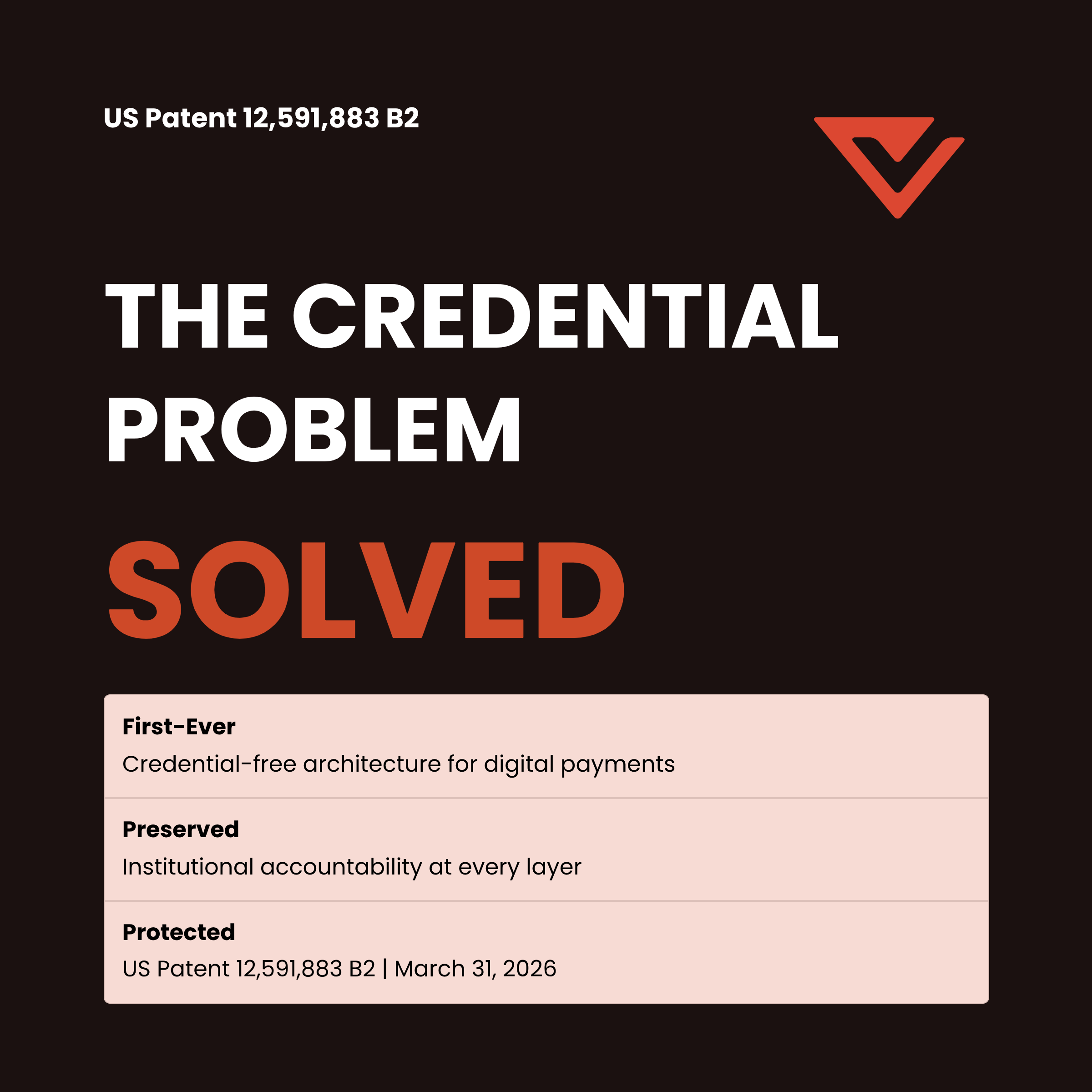
The first credential-free architecture that preserves institutional accountability in the tokenized economy
25 years solving symptoms, never questioning the assumption: payments require sharing credentials. USPTO confirmed we solved it. Every network, processor, and bank decides: build on this or around it”
BOSTON, MA, UNITED STATES, April 23, 2026 /EINPresswire.com/ -- **Granted after a multi-year USPTO examination— John Farrell, Chief Executive Officer, Vaiu Global
**Upends economics for card networks, processors, wallets, stablecoins, cross-border, CBDCs and banks - and eliminates credential risk across any sector requiring secure value transfer
Vaiu Global today announced that the United States Patent and Trademark Office has granted the patent that rewrites the operating assumptions of the global payments system. After a multi-year examination of every relevant prior art reference, the USPTO has confirmed VAIU's Transaction Key architecture as the first method for authorizing and executing a digital payment without requiring a persistent credential, while preserving institutional accountability.
Every payment system today — traditional and tokenized — requires sharing a persistent, reusable credential. For the first time, that requirement is eliminated. Transaction Keys eliminate credential risk not just for payments, but for any sector requiring secure value transfer. And the instruction itself — an ephemeral Transaction Key — can now carry the intent and context that traditional payments strip away in transit. The consequences reach across every layer of the payments stack: card networks, processors, digital wallets, stablecoin and tokenized-deposit issuers, cross-border providers, CBDC programs, and deposit-taking institutions of every size.
US Patent No. 12,591,883 B2, "Methods and Systems for Creating and Controlling Use of Transaction Keys," was issued March 31, 2026. The architecture generates session-scoped, single-use Transaction Keys at the moment of authorization — each one carrying the instruction, intent and context, expiring on use, and leaving no reusable credential footprint. It is blockchain-compatible but not blockchain-dependent, operating on top of existing payment rails rather than replacing them.
"The Transaction Key is the first payment infrastructure that is — credential-free, device-independent and institution-accountable,” said John Farrell, chief executive officer of VAIU Global. "The industry has been building better versions of the same architecture for 25 years — faster cards, cheaper rails, instant settlement, tokenized deposits, stablecoins — each one solving a symptom, none of them questioning the founding assumption that a payment requires sharing a persistent credential. The USPTO has now confirmed that VAIU has solved it. Every network, every processor, and every bank now has to decide whether to build on top of this architecture — or around it,” Farrell said.
The announcement comes as US banks face $6.6 trillion in deposits at structural risk following the GENIUS Act (Treasury Borrowing Advisory Committee3), with Jefferies Research1 forecasting 3 to 5 percent deposit runoff to stablecoin issuers, and the FDIC confirming that stablecoin holders carry zero federal deposit insurance2. The result has been a binary choice for U.S. banks: issue a stablecoin and displace the deposit, or do nothing and lose the customer. Transaction Keys resolve that binary — but the architecture addresses a flaw that predates the stablecoin debate and exists equally across card networks, cross-border rails and CBDC design.
“We asked a question the industry stopped asking decades ago: Does authorizing a payment require exposing a credential? The answer is no. The USPTO's examination confirmed it's unprecedented. Transaction Keys carry the authorization without the credential — no card number, no account number, no reusable identifier anywhere in the flow — ephemeral, single-use codes," said Reza Jalili, inventor of the Transaction Key and founder and chief technology officer of
VAIU Global is engaging directly with payment networks, processors, core banking and payments platform providers, digital wallets, stablecoin and tokenized-deposit issuers, cross-border providers, and financial institutions of all sizes across Europe, Africa, and North America, with pilot activity underway in Central and Eastern Europe and West Africa. A Vaiu Ephemeral Transaction Key Briefing Document — covering technical detail, ecosystem-by-ecosystem impact, and executive biographies — is available on the company website.
- ENDS -
About Vaiu Global
VAIU Global is a payments infrastructure company. Its patented Transaction Key architecture — the authorization operating system for banking — enables credential-free, device-independent, institution-accountable digital value transfer through ephemeral, institution-bound instructions, designed to operate inside any existing payment system. The company holds U.S. Patent No. 12,591,883 B2, granted March 31, 2026. Follow VAIU on LinkedIn.
Executive Contacts
John Farrell, chief executive officer — LinkedIn
Reza Jalili, Inventor, founder and chief technology officer — LinkedIn
Media Contact
Hello@vaiuglobal.com; pia@123.co
References
1. Jefferies Research, March 10, 2026. Deposit runoff forecast: 3–5% from US banks to stablecoin issuers over five years (analysts led by David Chiaverini). Reported via CoinDesk.
2. FDIC Chairman Travis Hill, March 11, 2026. Public statement confirming zero federal deposit insurance for stablecoin holders, including under pass-through arrangements. Reported via CoinDesk.
3. Treasury Borrowing Advisory Committee, April 30, 2025. "Digital Money" presentation. $6.6 trillion in U.S. bank deposits at structural risk treasury.gov.
Media Relations
123G
contact@123g.co
Legal Disclaimer:
EIN Presswire provides this news content "as is" without warranty of any kind. We do not accept any responsibility or liability for the accuracy, content, images, videos, licenses, completeness, legality, or reliability of the information contained in this article. If you have any complaints or copyright issues related to this article, kindly contact the author above.
