

India’s Young Workforce Could Become the World’s Largest AI Advantage
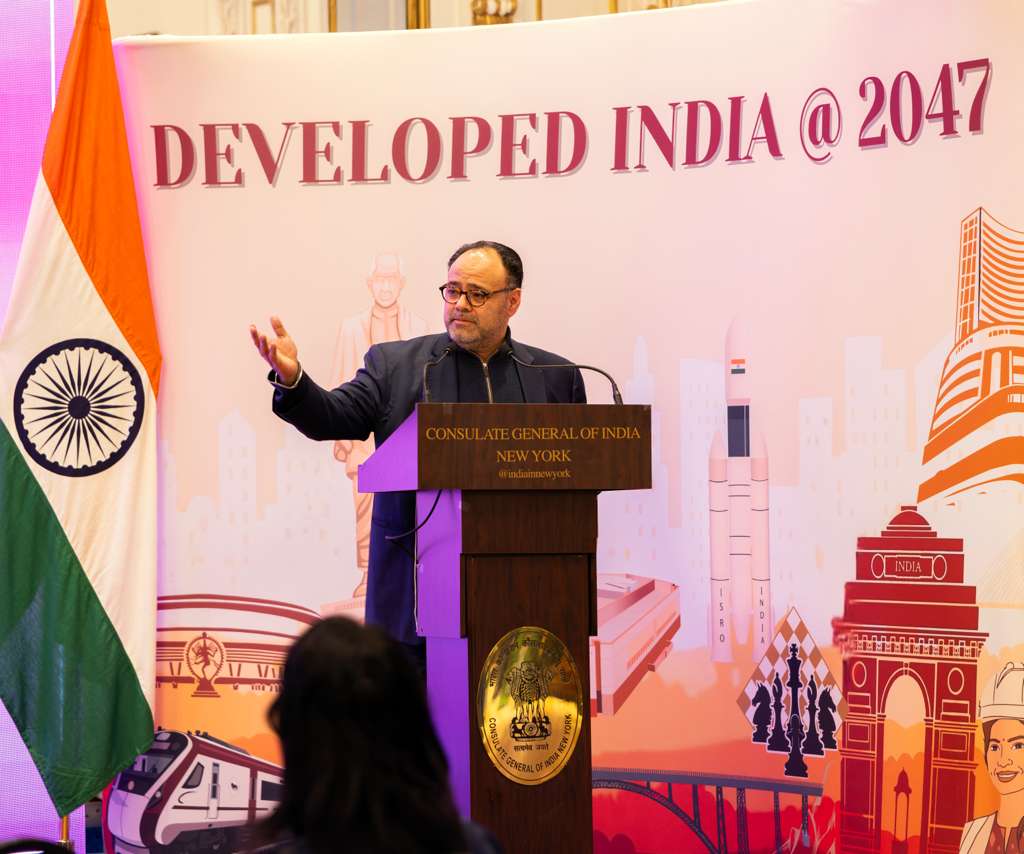
Harjiv Singh, CEO and Founder, CambrianEdge.ai
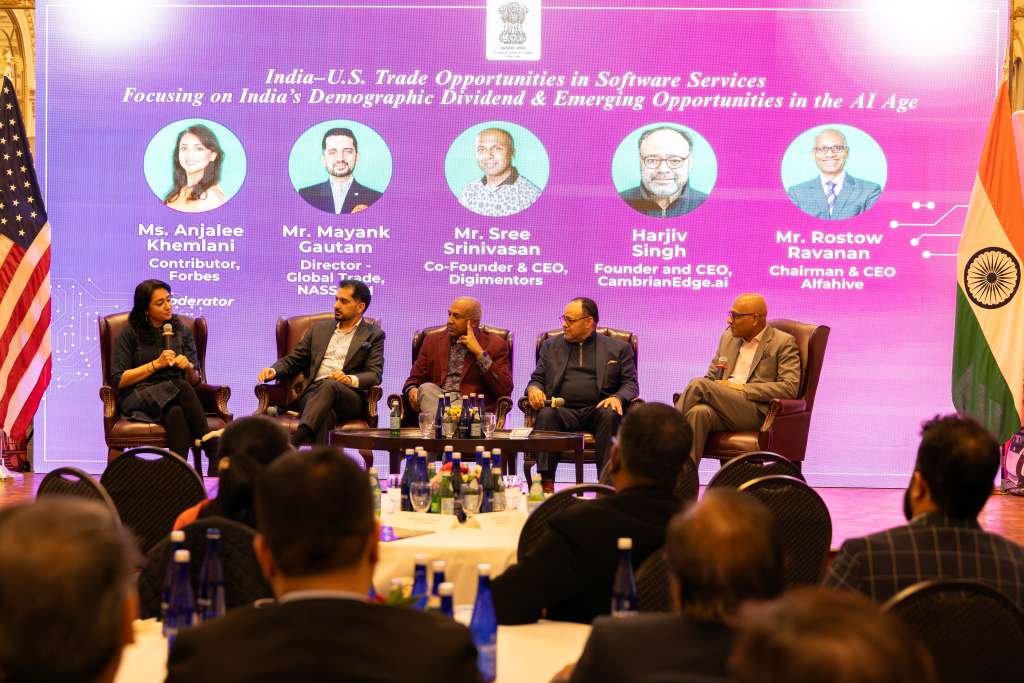
L-R: Anjalee Khemlani, Mayank Gautum, Sree Srinivasan, Harjiv Singh and Rostow Ravanan
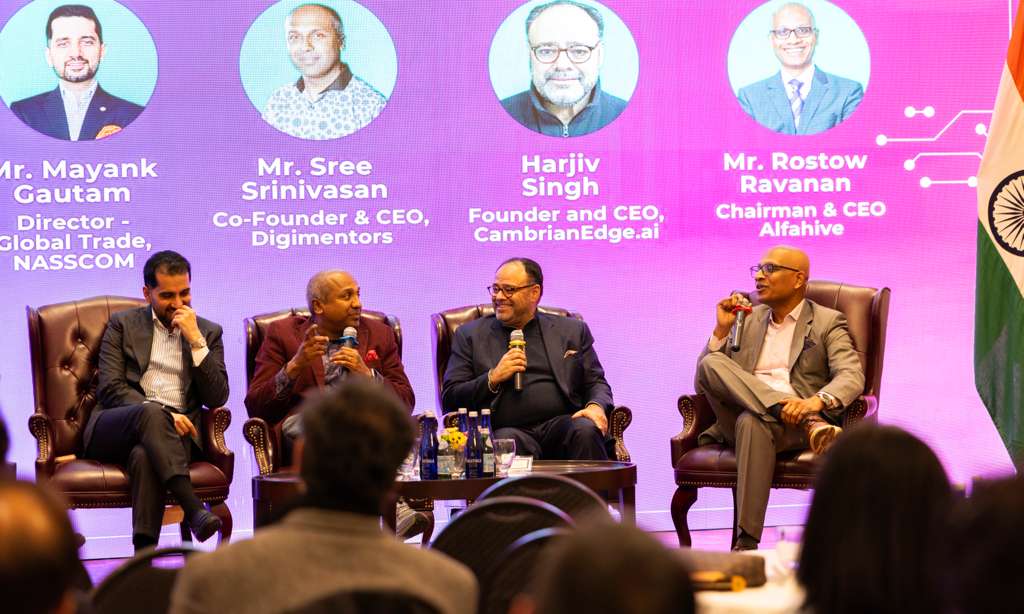
Panel discussion at the Consulate General of India in New York
Panel discussion at the Indian Consulate in New York discussed how India can lead the AI era by closing the gap between AI literacy and true AI fluency now.
NEW YORK, NY, UNITED STATES, April 10, 2026 /EINPresswire.com/ -- Research published by Anthropic in 2025 found a 14% decline in hiring rates for workers aged 22 to 25 in AI-exposed occupations. India's median age is 28. Those two numbers opened a closed-door panel discussion Tuesday at the Consulate General of India in Midtown Manhattan not as a warning, but as a starting point for a larger argument about timing and readiness.The event, hosted by the Consulate General of India in New York, and organized with NASSCOM, India's premier technology industry body, and CambrianEdge.ai, an AI-native marketing operations platform, drew technology executives, trade officials, and media figures to examine whether India's demographic advantage remains a strategic asset in an economy being restructured by artificial intelligence.
Forbes Contributor Anjalee Khemlani, moderated the panel. Panelists included Harjiv Singh, Founder and Chief Executive Officer of CambrianEdge.ai; Mayank Gautam, Director of Global Trade at NASSCOM; Sree Srinivasan, Co-founder and Chief Executive Officer of DigiMentors and Rostow Ravanan, Chairman and Chief Executive Officer of AlfaHive.
The panel said AI is dissolving the line between IT services and software product development, giving Indian firms a path to become architects of AI-powered delivery. India's demographic profile, they said, gives it a credible shot at becoming the world's largest AI user base — a position that, if structurally harnessed through smart policy and investment in education, represents a force multiplier unlike any the country has seen before.
According to the Stanford HAI 2025 AI Index Report, 83% of people in China and 80% in Indonesia view AI as more beneficial than harmful; in the United States, that figure is 39%. Mayank Gautam put it plainly, calling AI the biggest opportunity for democratization of this generation. A young population entering the workforce at the exact moment the barrier to building with AI has collapsed is not a coincidence - it is a structural tailwind that India is positioned to capture.
Harjiv Singh drew a distinction between AI literacy - knowing how to use the tools - and AI fluency: knowing when to trust the output, when to override it, and how to direct AI toward decisions that require human judgment. That gap, he said, is where India's next competitive advantage will be built or lost. Harjiv challenged the room to stop tracking which large language model is winning the week's headlines and focus instead on what value AI is actually creating for organizations and society at large.
According to the Stanford HAI 2025 AI Index Report, AI adoption among businesses jumped from 55% to 78% in a single year a pace that rewards organizations already building fluency and leaves those waiting behind.
Sree Srinivasan brought a forward lens to what AI is already changing at the craft level. Srinivasan focused on the rise of "vibe coding", the practice of building functional, deployable applications through natural language prompts using tools like Cursor, without writing every line of code from scratch. The technical floor for building software has dropped sharply, and for India's digitally native young workforce, this is a structural opening. A 22-year-old in Hyderabad or Jaipur with a clear problem to solve and a working grasp of these tools can now build and deploy at a speed that was simply not possible two years ago. India, Srinivasan argued, is better positioned than almost any country to take advantage of that.
The opportunity is real but it will not capture itself," Sree Srinivasan said.
In 2025, venture capital investments in AI firms globally made up over half (61%, USD 258.7 billion) of all VC investment (USD 427.1 billion), doubling its 2022 share (30%), according to the OECD .
Rostow Ravanan said the infrastructure required to absorb that capital power, connectivity, talent pipelines is still catching up to the pace of deployment, and that closing that gap is precisely what converts India's demographic dividend into a durable economic advantage. The scale of incoming investment, he said, makes this the right moment to accelerate that build-out.
The panel invoked former World Bank President Ajay Banga's framing: train this generation well, and the dividend becomes a gift that keeps giving. Training, the panel said, must now mean AI literacy as a baseline not vocational skill alone, not coding bootcamps alone, but a systemic rethinking of how young Indians are equipped to operate in a world where AI is the starting point.
Harjiv Singh closed with the stakes as he sees them not just for India, but for every country watching the same inflection point arrive.
"The challenge the world faces is to rethink education completely for the world of AI. The world's education system still follows what worked for the industrial age. We need to reinvent it for the AI age. This means teaching every child to ask better questions to be curious explorers to unleash the power of human imagination coupled with the power of AI," Harjiv Singh said.
ABOUT CAMBRIANEDGE.AI
CambrianEdge.ai is the world’s first human-led, AI-native marketing platform that unifies content creation, distribution, research, and analytics while building AI literacy through real work. Its human-in-the-loop design ensures AI handles operational complexity while marketers maintain creative control and develop practical fluency with every task.
Learn more at www.cambrianedge.ai and follow us on LinkedIn and X
Keeret Singh Heer
CambrianEdge.ai
+1 917-940-3294
keeret@thegutenberg.com
Visit us on social media:
LinkedIn
Instagram
X
Legal Disclaimer:
EIN Presswire provides this news content "as is" without warranty of any kind. We do not accept any responsibility or liability for the accuracy, content, images, videos, licenses, completeness, legality, or reliability of the information contained in this article. If you have any complaints or copyright issues related to this article, kindly contact the author above.
