

Biosurfactants Market Outlook: Europe & North America Lead Sustainable Surfactant Shift with Evonik, BASF & Stepan
Biosurfactants Market
Biosurfactants Market is segmented by Product (MES, Rhamnolipids, Sophorolipids, APG, and Others), Application (Household Detergents, Personal Care)
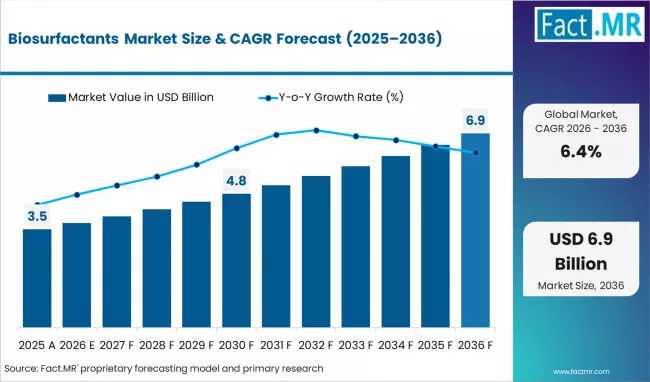
ROCKVILLE, MD, UNITED STATES, April 8, 2026 /EINPresswire.com/ -- Biosurfactants Market: Transitioning from Niche Green Chemistry to Industrial Mainstay. The global Biosurfactants Market, valued at USD 3.50 billion in 2025, is poised for a transformative decade. According to the latest strategic analysis, the industry is projected to reach USD 3.72 billion in 2026 and surge to USD 6.93 billion by 2036. This growth, representing a 6.4% CAGR, is fueled by a structural shift in procurement as global consumer goods giants move away from petrochemical-derived surfactants toward bio-based, biodegradable alternatives.For Details Deep insights, Please Request A sample report for Free: https://www.factmr.com/connectus/sample?flag=S&rep_id=11911
Market Dynamics: Drivers and Structural Shifts
The demand for biosurfactants is no longer merely a ""green"" preference; it is a regulatory and functional necessity. Key drivers include:
Regulatory Compulsion: Revisions to the EU Detergent Regulation regarding biodegradability and aquatic toxicity are forcing a massive reformulation of household detergents.
Clean-Label Personal Care: The beauty industry is rapidly adopting rhamnolipids and sophorolipids due to their low skin irritation potential and mild cleansing properties.
Enhanced Oil Recovery (EOR): Oilfield service companies are deploying rhamnolipid formulations to reduce environmental liabilities during extraction processes.
Segmental Analysis & Product Outlook
The market is bifurcated by established oleochemical surfactants and emerging fermentation-derived variants.
By Product: The Dominance of MES
Methyl Ester Sulfonates (MES): Projected to command 33.0% of the market in 2026. MES has reached a critical cost-parity threshold with petrochemical Linear Alkylbenzene Sulfonate (LAS), making it the primary choice for cost-sensitive laundry and dishwashing segments.
Rhamnolipids: Expected to be the fastest-growing segment with a 10.4% CAGR. Its antimicrobial properties make it indispensable for premium ""clean beauty"" portfolios.
Alkyl Polyglucosides (APG): Highly valued for their stability and synergy with other bio-based agents in industrial cleaners.
By Application: Detergents Lead the Charge
Household Detergents: Account for 45.0% of demand in 2026. The scale of this segment is driven by retailer sustainability scorecards and the mass-market shift toward ""eco-certified"" products.
Regional Performance: India and China at the Forefront
The Asia-Pacific region is the engine of growth, supported by massive oleochemical feedstock availability (Palm and Coconut oil).
Country CAGR (2026-2036) Primary Driver
India 7.9% Expanding personal care sector & government bio-incentives.
China 7.4% Industrial cleaning growth & environmental compliance.
Brazil 6.6% Integration with sugarcane-based biorefineries.
USA 5.9% Mature consumer demand for ""Clean Label"" products.
Germany 5.6% Stringent EU regulatory adherence (REACH).
Competitive Landscape & Strategic Positioning
The competitive environment is defined by technological mastery over fermentation yields and feedstock integration.
Key Market Participants:
Evonik Industries AG (12.5% Share): Leading through massive scale-up of rhamnolipid production.
Allied Carbon Solutions: Focused on high-efficiency MES for the detergent industry.
Jeneil Biotech & Saraya Co.: Pioneers in microbial fermentation and specialty sophorolipids.
Solvay S.A. & Stepan: Expanding portfolios in high-purity APGs and bio-based blends.
Analyst Insights: The Cost-Parity Inflection Point
""The single most consequential factor for this market is the price gap between fermentation-derived surfactants and commodity petrochemicals,"" states Shambhu Nath Jha, Principal Consultant at Fact.MR. ""While MES and APG are already cost-competitive, rhamnolipids still command a premium. Producers who master continuous fermentation and strain engineering will be the ones to capture high-margin segments in oilfield and personal care.""
For instant access to this report, click "Buy Now" or connect with our analyst for customization:
https://www.factmr.com/checkout/11911
Investment Opportunities & Future Outlook
For decision-makers, the biosurfactants sector offers a USD 3.21 billion incremental opportunity over the next ten years. Investment should focus on:
Downstream Processing (DSP): Reducing the cost of separating biosurfactants from fermentation broths.
Strategic Off-take Agreements: Consumer goods companies should secure multi-year supply contracts now to hedge against future supply constraints during the mass-reformulation phase.
Feedstock Diversification: Utilizing non-food agricultural waste to insulate production from fluctuations in the vegetable oil market.
The future of the surfactant industry is undeniably bio-based. As production scales and costs align, the transition from petrochemical dependence to biological circularity will define the next generation of industrial chemistry.
Related Fact.MR Reports
Polymer Surfactants Market https://www.factmr.com/report/4404/polymer-surfactants-market
Microbial Biosurfactants Market https://www.factmr.com/report/microbial-biosurfactants-market
Sugar-based Surfactants Market https://www.factmr.com/report/sugar-based-surfactants-market
Surfactants Market https://www.factmr.com/report/surfactants-market
S. N. Jha
Fact.MR
+ +1 628-251-1583
email us here
Legal Disclaimer:
EIN Presswire provides this news content "as is" without warranty of any kind. We do not accept any responsibility or liability for the accuracy, content, images, videos, licenses, completeness, legality, or reliability of the information contained in this article. If you have any complaints or copyright issues related to this article, kindly contact the author above.
