

Odour Control Textiles Market : North America Leads Innovation with Polygiene, Microban & HeiQ Expanding Solutions
Odour Control Textiles Market
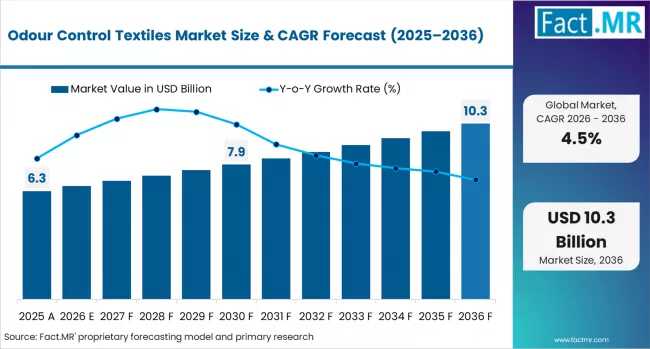
Global Odour Control Textiles Market Poised to Hit USD 10.29 Billion by 2036 as ""Multi-Mechanism"" Systems Replace Basic Antimicrobials
ROCKVILLE, MD, UNITED STATES, March 31, 2026 /EINPresswire.com/ -- The global landscape for performance fabrics is undergoing a seismic shift. No longer satisfied with simple ""anti-stink"" finishes, the Odour Control Textiles Market, valued at USD 6.63 billion in 2026, is projected to surge to USD 10.29 billion by 2036.According to the latest market analysis by Fact.MR, this 4.5% CAGR expansion represents an absolute dollar opportunity of USD 3.66 billion. The growth is fueled by a structural transition: textile specification engineers are moving away from basic treatments toward engineered, multi-mechanism systems that combine silver-ion, zinc-pyrithione, and advanced microencapsulation.
For Details Deep insights, Please Request A sample report for Free: https://www.factmr.com/connectus/sample?flag=S&rep_id=849
Executive Summary: The ""Wash-Durability"" Threshold
For decision-makers in the apparel and healthcare supply chains, the message is clear: durability is the new currency. Textile treatment suppliers failing to demonstrate efficacy across a 50-cycle standardized wash threshold are increasingly excluded from premium contracts. As regulatory bodies like REACH (Europe) and the EPA (USA) tighten biocidal registrations, the industry is pivoting toward non-toxic, bio-based adsorbents that offer ""wash-resistant"" longevity without compromising environmental ESG metrics.
Quick Stats: Market at a Glance (2026–2036)
Metric Details
Current Market Value (2026) USD 6.63 Billion
Projected Market Value (2036) USD 10.29 Billion
Compound Annual Growth (CAGR) 4.5%
Top Performing Segment Apparel & Footwear (41% Share)
Fastest Growing Region India & China (5.0% CAGR)
Leading Technology Nanotechnology (6.1% CAGR)
Strategic Investment Segments
1. End Use: Apparel & Footwear Dominance
Holding a 41% share in 2026, this segment remains the primary engine of innovation. Beyond simple gym wear, ""smart"" footwear—capable of gait analysis and posture adjustment—is integrating odour control as a baseline hygiene requirement for the aging population and fitness enthusiasts alike.
2. Technology: The Nanotech Frontier
Growing at a remunerative 6.1% CAGR, nanotechnology (specifically silver and zinc oxide nanoparticles) allows for uniform distribution across fibers. This ensures fabric breathability and softness remain intact while providing hospital-grade bioburden reduction.
3. Sector: Industrial & Healthcare Hygiene
The industrial sector is expanding at 5.4% CAGR. In high-heat environments like food processing and chemical handling, odour-control is shifting from a ""comfort feature"" to a mandatory Occupational Health and Safety (OHS) standard.
Regional Powerhouses: The Growth Map
While the United States (4.2% CAGR) remains a mature innovation hotspot driven by ""athleisure"" trends, the Asia-Pacific region is the volume leader.
China (5.0% CAGR): Leveraging massive scale and low-cost microencapsulation.
South Korea (4.6% CAGR): Leading in silver-free antimicrobial innerwear.
India: Currently the fastest-growing industry globally for odour-control adoption.
The Competitive Edge: Top 5 Market Leaders
The market is currently concentrated among five key players who dictate the technological roadmap:
Heiq Materials AG (18-20% Share): The gold standard in bio-based ""Heiq Fresh"" technologies.
Sciessent LLC (14-16% Share): Preferred for military-grade zeolite-based adsorbents.
Trevira GmbH (12-14% Share): Dominates institutional healthcare and flame-resistant fibers.
Dyntex GmbH (8-10% Share): The choice for luxury European outdoor brands (e.g., Moncler).
Thompson Tee (2-3% Share): Specialized niche player in consumer-direct functional wear.
Analyst Take: Buy vs. Build?
Investing in combined antimicrobial and microencapsulation platforms represents the clearest pathway for differentiation. Brands maintaining single-technology specifications risk consumer dissatisfaction as competitors demonstrate measurably longer odour-free wear intervals.
""The industry is moving from transactional sourcing to long-term co-development. Fashion firms are now entering sole-source agreements with chemical suppliers to lock in proprietary odour-control tech before it hits the mass market."" — Fact.MR Senior Analyst.
For instant access to this report, click "Buy Now" or connect with our analyst for customization: https://www.factmr.com/checkout/849
Related Market Insights
Odour Control Textiles Market https://www.factmr.com/report/849/odour-control-textiles-market
Absorbable Nonwoven Textiles Market https://www.factmr.com/report/3349/absorbable-nonwoven-textiles-market
Bioplastic Textiles Market https://www.factmr.com/report/bioplastic-textiles-market
Biomedical Textiles Market https://www.factmr.com/report/biomedical-textiles-market
S. N. Jha
Fact.MR
+1 628-251-1583
email us here
Legal Disclaimer:
EIN Presswire provides this news content "as is" without warranty of any kind. We do not accept any responsibility or liability for the accuracy, content, images, videos, licenses, completeness, legality, or reliability of the information contained in this article. If you have any complaints or copyright issues related to this article, kindly contact the author above.
