

Spinal Cord Stimulators Market Forecast to Hit US$ 6.6 Bn by 2033 | Persistence Market Research
spinal cord stimulators (SCS) market
Spinal cord stimulators market is expanding due to rising chronic pain cases, neuromodulation advancements, and growing adoption of non-opioid pain therapies.
LONDON, UNITED KINGDOM, March 16, 2026 /EINPresswire.com/ -- The global spinal cord stimulators (SCS) market is expected to reach approximately US$ 3.7 billion in 2026 and is projected to grow to around US$ 6.6 billion by 2033, registering a compound annual growth rate (CAGR) of 8.6% during the forecast period. Market growth is driven by technological advancements, expanding reimbursement coverage for chronic pain therapies, and increasing prevalence of neuropathic pain conditions worldwide. Spinal cord stimulation has become an important treatment option for patients who do not respond adequately to conventional pharmacological therapies.
Chronic pain continues to represent a major healthcare challenge globally, affecting nearly one-fifth of the adult population. Neuropathic pain alone impacts approximately 7–10% of individuals in developed countries. The growing aging population and increasing incidence of degenerative spine disorders are expanding the candidate pool for neuromodulation therapies. Additionally, the rising burden of diabetes is contributing to an increase in painful diabetic neuropathy cases, further strengthening demand for spinal cord stimulation systems.
Download Your Free Sample & Explore Key Insights: https://www.persistencemarketresearch.com/samples/36167
Key Market Drivers
One of the primary factors driving the spinal cord stimulators market is the expansion of reimbursed indications for neuropathic pain conditions. Healthcare systems and regulatory authorities are recognizing spinal cord stimulation as a cost-effective treatment for chronic refractory pain. Several public and private payers are expanding coverage criteria for neuromodulation therapies as part of structured pain management strategies.
Another major growth driver is the global shift toward opioid-sparing pain management solutions. Governments and healthcare providers are increasingly encouraging non-pharmacological therapies to reduce opioid dependence and associated healthcare costs. Spinal cord stimulation provides long-term pain relief while reducing reliance on opioid medications, making it a preferred option in value-based healthcare frameworks.
Technological innovation is also accelerating market expansion. High-frequency stimulation systems and closed-loop neuromodulation technologies are improving treatment precision and clinical outcomes. Closed-loop systems continuously adjust stimulation levels based on real-time neural feedback, enabling more consistent pain control and improving patient satisfaction.
Get Custom Insights Designed for Your Businecss: https://www.persistencemarketresearch.com/request-customization/36167
Market Challenges
Despite strong growth potential, the spinal cord stimulators market faces certain challenges. The high upfront cost associated with device implantation remains a significant barrier in many healthcare systems. The total cost of therapy, including the device and surgical procedure, can range between US$ 30,000 and US$ 60,000 in developed countries. While long-term studies demonstrate cost-effectiveness through reduced hospital visits and medication use, initial capital requirements can slow adoption in publicly funded healthcare systems.
Another challenge is variability in patient response to spinal cord stimulation therapy. Non-responder rates are estimated to range from 20% to 30%, depending on patient selection and clinical indication. In some cases, devices may need to be removed due to inadequate pain relief or complications, resulting in explantation rates of around 10–15% within five years. These factors have increased scrutiny from healthcare payers and regulatory authorities regarding long-term clinical outcomes.
Clinical Indication Insights
Failed back surgery syndrome (FBSS), also known as persistent spinal pain syndrome, remains the leading clinical indication for spinal cord stimulation therapy. This segment is expected to account for nearly 45% of global market revenue in 2026. The dominance of this indication is supported by well-established reimbursement policies, extensive clinical evidence, and consistent referral pathways between spine surgeons and pain specialists.
Painful diabetic neuropathy is emerging as the fastest-growing clinical application for spinal cord stimulators. The segment is projected to record a CAGR of approximately 12% during the forecast period. Rising global diabetes prevalence and increasing awareness among physicians regarding neuromodulation benefits are contributing to growth in this segment.
Regional Insights
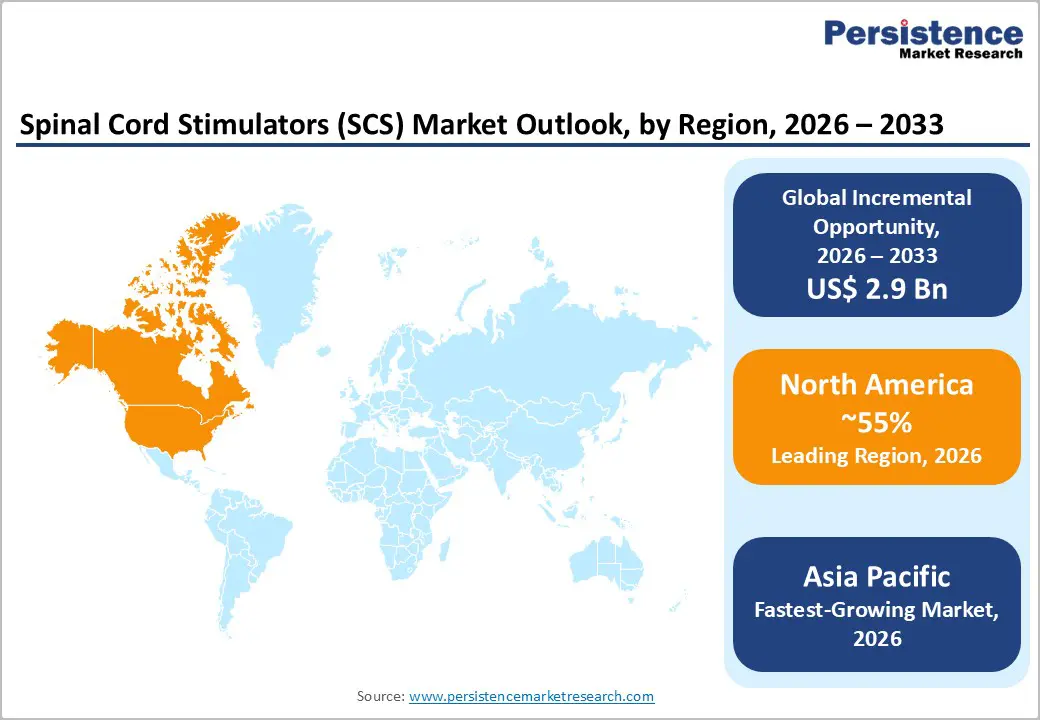
North America is anticipated to dominate the global spinal cord stimulators market, accounting for approximately 55% of market share in 2026. The region benefits from advanced healthcare infrastructure, strong reimbursement coverage, and a large number of trained neuromodulation specialists. The presence of leading device manufacturers and rapid adoption of advanced technologies further support regional market growth.
Europe represents the second-largest regional market, holding an estimated 25% share in 2026. Growth in this region is supported by aging populations, increasing prevalence of neuropathic pain conditions, and structured health technology assessment frameworks that support evidence-based adoption of advanced therapies.
Asia Pacific is projected to be the fastest-growing regional market, expanding at a CAGR of around 11% through 2033. Rising diabetes prevalence, expanding private healthcare infrastructure, and increasing investment in advanced medical technologies are key factors driving growth in countries such as China, India, Japan, and Australia.
Checkout Now & Download Complete Market Report: https://www.persistencemarketresearch.com/checkout/36167
Competitive Landscape
The spinal cord stimulators market is highly consolidated, with a small number of major manufacturers controlling the majority of global revenue. Leading companies are focusing on technological differentiation, waveform innovation, and digital integration to maintain competitive advantage. High-frequency stimulation systems, closed-loop platforms, and enhanced MRI compatibility are among the key innovation areas shaping product development.
Market Segmentation
By Waveform
Conventional/Tonic
High-Frequency (10 kHz)
Burst Stimulation
Closed-Loop/Evoked Compound Action Potential (ECAP)-Controlled
Hybrid Platforms
By Power Source
Rechargeable Implantable Pulse Generators (IPGs)
Non-Rechargeable IPGs
Dorsal Root Ganglion (DRG) Systems
External/Trial Stimulator Systems
By Clinical Indication
Failed Back Surgery Syndrome (FBSS)
Complex Regional Pain Syndrome (CRPS)
Painful Diabetic Neuropathy (PDN)
Ischemic Limb Pain/Peripheral Vascular Disease
Cancer-Related Pain
Chronic Musculoskeletal & Mixed Neuropathic Pain
By Region
North America
Europe
East Asia
South Asia & Oceania
Latin America
Middle East & Africa
Future Outlook
The future of the spinal cord stimulators market appears promising as ongoing technological innovation, increasing chronic pain prevalence, and supportive healthcare policies continue to drive adoption. The integration of digital health technologies, artificial intelligence-assisted programming, and improved patient selection tools is expected to enhance treatment outcomes and expand the clinical applications of spinal cord stimulation.
Read Related Reports:
Perineal Care Market: Global perineal care market to grow from US$1.4 billion in 2026 to US$1.9 billion by 2033, registering a 4.6% CAGR during 2026–2033.
Healthcare Safety and Risk Management Solutions Market: Global healthcare safety & risk management solutions market to grow from US$2.6 Bn in 2026 to US$5.2 Bn by 2033, registering a 10.4% CAGR.
Persistence Market Research
Persistence Market Research Pvt Ltd
+1 646-878-6329
email us here
Visit us on social media:
LinkedIn
Instagram
Facebook
YouTube
X
Legal Disclaimer:
EIN Presswire provides this news content "as is" without warranty of any kind. We do not accept any responsibility or liability for the accuracy, content, images, videos, licenses, completeness, legality, or reliability of the information contained in this article. If you have any complaints or copyright issues related to this article, kindly contact the author above.
